Chemical Incident Response Platform Simulation (ChIRPS)
📌 Project Overview
ChIRPS is a web-based simulation and training platform designed to model complex chemical, biological, radiological, and nuclear (CBRN) emergency response scenarios. The system enables facilitators to run realistic, multi-agency incident exercises while capturing detailed, time-ordered decision-making and operational actions.
The platform bridges the gap between traditional training exercises and real-world incident complexity by introducing dynamic, AI-driven scenario evolution that accounts for human behavior and crowd dynamics.
🎯 Problem Statement
Training and exercising for low-frequency, high-consequence threats like CBRN incidents is increasingly difficult at all levels of response due to resource limitations, personnel attrition, and the growing number of high-frequency threats responders must prepare for.
Current Exercise Limitations:
- Functional Exercises excel at assessing specific tactics and multi-agency coordination, but require pulling responders “off the line” or bringing them in during off-shifts
- Table Top Exercises identify communication and coordination challenges but lack realism
- Neither approach adequately simulates one of the most challenging response aspects: unpredictable human behavior and crowd dynamics
ChIRPS addresses these gaps by providing near real-time problem-solving scenarios with AI-generated injects and crowd behavior elements that stress-test response capabilities.
✨ Key Capabilities
- Multi-Exercise Support: Run concurrent simulations across different scenarios and agencies
- Role-Based Interaction: Distinct interfaces and permissions for facilitators, responders, and observers
- Event-Driven Simulation Engine: Dynamic scenario evolution based on responder actions
- Immutable Event Logging: Complete audit trail for compliance and replay analysis
- Materialized State Views: Real-time simulation status and decision tracking
- After Action Reports (AAR): Automated documentation of decisions and outcomes
- API-Driven Architecture: Extensible design for analytics, UI, and third-party integration
🏗 High-Level Architecture
The system employs a layered, event-driven architecture with clear separation of concerns:
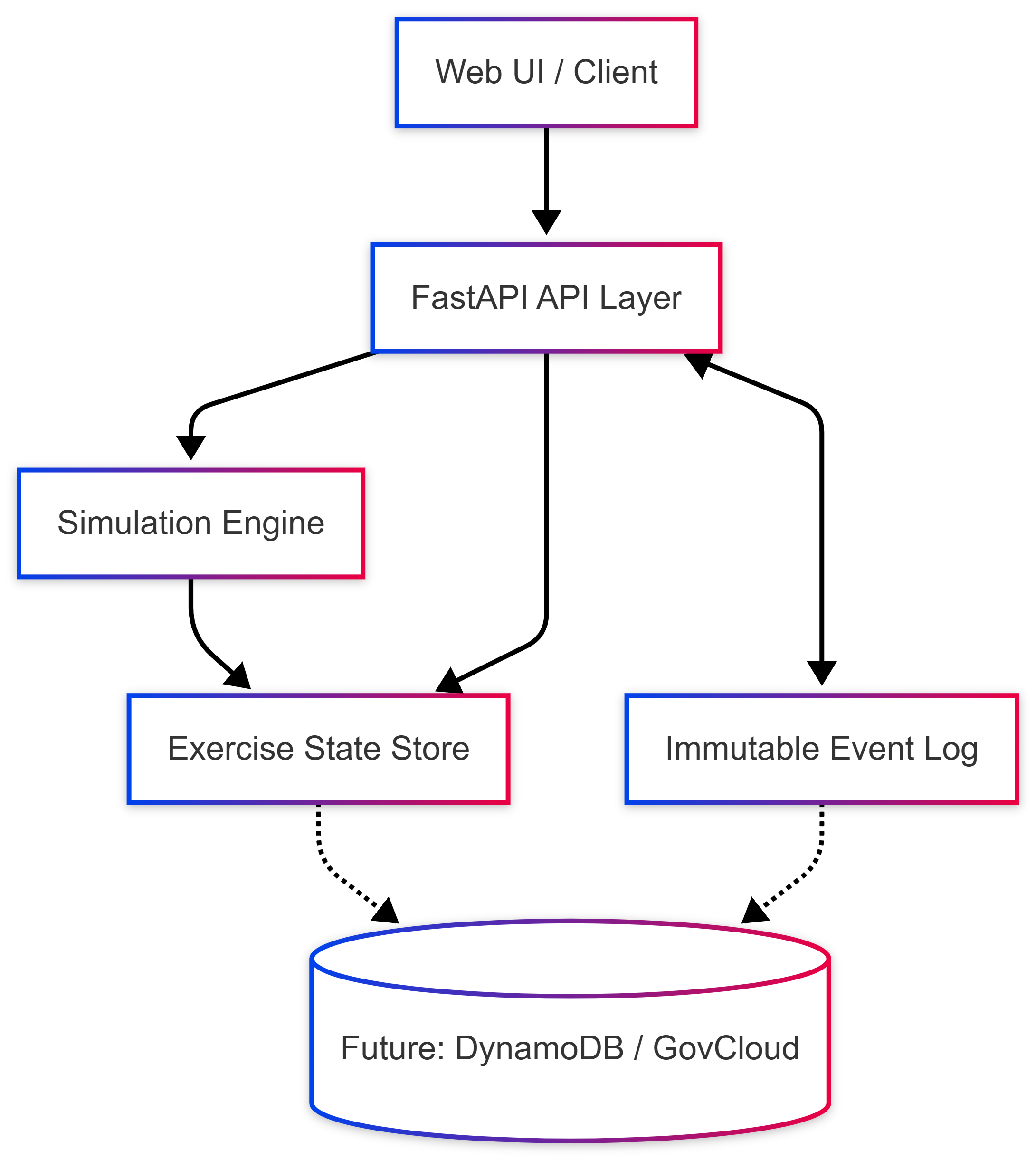
Architectural Principles:
- Simulation Logic: Domain-driven design with deterministic simulation rules
- API Orchestration: FastAPI-based service layer for all interactions
- Current State: Materialized views for real-time query performance
- Immutable History: Event sourcing pattern for complete audit trail and replay capability
This design supports traceability, debugging, and compliance use cases common in emergency management and government systems.
🛠 Tools & Technologies
| Layer | Technology | Purpose |
|---|---|---|
| Language | Python | Core application development and business logic |
| API Framework | FastAPI | High-performance async API with automatic documentation |
| Data Validation | Pydantic | Type-safe models and data validation |
| Architecture | Event Sourcing | Immutable event log with materialized views |
| Design Pattern | Repository Pattern | Persistence abstraction for future database flexibility |
| API Design | API-First | Clean separation enabling multiple client types |
🚀 Future Roadmap: Cloud Scale
The platform is architected for deployment to AWS GovCloud to support sensitive-but-unclassified (SBU) use cases:
- Cloud Infrastructure: AWS GovCloud compliance and security controls
- Database: DynamoDB for scalable event storage
- Security: IAM-based access control and encryption at rest/in transit
- Compliance: Audit logging and data retention patterns for government requirements